Chest pain control with kinesiology taping after lobectomy for lung cancer: initial results of a randomized placebo-controlled study
Andrea Imperatoria, Annamaria Grande, Massimo Castiglioni, Laura Gasperini, Agnese Faini, Sebastiano Spampatti, Elisa Nardecchia, Lorena Terzaghi, Lorenzo Dominioni, Nicola Rotolo
Interactive Cardiovascular and Thoracic Surgery, 2016 · RCT, placebo-kontrollert
Løft og smertelindringBrystPostoperativ
Les sammendrag
Objectives: Kinesiology taping (KT) is a rehabilitative technique performed by the cutaneous application of a special elastic tape. We tested the safety and efficacy of KT in reducing postoperative chest pain after lung lobectomy.
Methods: Ninety-two eligible patients were randomized to KT (n = 46) or placebo control (n = 46) after lobectomy. Standard postoperative analgesia was given in both groups. On postoperative day 1, KT was applied with standardized tape length, tension and shape over three defined skin areas: chest access site trigger point; ipsilateral deltoid/trapezius; lower anterior chest. Placebo tape mimicking KT was applied in the control group. Pain was self-assessed on a VAS (0–10) on days 1, 2, 5, 8, 9 and 30.
Results: No adverse events occurred. KT patients reported overall less thoracic pain, with significant differences on day 5 (median VAS 2 vs 3, P < 0.01) and day 8 (median VAS 1 vs 2, P < 0.05). On day 30, persistent chest pain (VAS ≥ 3) was less frequent in the KT group (7% vs 24%; P = 0.03).
Conclusions: KT after lung lobectomy is a safe and effective auxiliary technique for chest pain control.
Acute effects of scapular kinesiotaping on shoulder rotator strength, range of motion and acromiohumeral distance in asymptomatic overhead athletes
Harput G, Guney H, Toprak U, Colakoglu F, Baltaci G
Journal of Sports Medicine and Physical Fitness, 2017 · Akutt effektstudie
Skapulær teknikkSkulderAHDIdrett
Les sammendrag
Background: There is limited information on whether scapular taping affects acromiohumeral distance (AHD) and shoulder function. The aim was to investigate acute effects of scapular Kinesio Taping on shoulder internal/external rotation strength, ROM and AHD in asymptomatic overhead athletes.
Methods: Forty-one volleyball athletes were included. Shoulder IR and ER ROM, total rotation ROM, AHD, and isometric IR and ER strength were tested before and after taping.
Results: Scapular taping increased shoulder IR (P < 0.001), total ROM (P < 0.001), AHD (P < 0.001), and IR (P = 0.002) and ER strength (P = 0.006). ER ROM and ER:IR ratio did not change significantly.
Conclusions: Scapular taping may enhance AHD, shoulder rotator strength and ROM, and could be recommended for shoulder exercise training and prevention of subacromial impingement syndrome.
The effect of trapezius muscles kinesio taping on pain, functional movement of shoulder joint and lateral scapular slide in athletes with impingement syndrome
Mallaee F, Naseri N, Gotbi N
Journal of Modern Rehabilitation, Tehran, 2016 · Klinisk studie
TrapeziusImpingementSkulderbladIdrett
Les sammendrag
Background and aim: Impingement syndrome is a frequent cause of shoulder injury in overhead sports. Scapular kinematics play an important role in normal shoulder function. This study investigated effects of kinesio taping of the trapezius on pain, functional shoulder movements and lateral scapular slide in athletes with impingement syndrome.
Methods: Fifteen athletes (mean age 30.5 years) with impingement syndrome were assessed for pain (VAS), functional movements and lateral scapular slide test in three positions. Kinesio taping was applied to the trapezius muscles; reassessment was done after 20 minutes, 72 hours and 6 days.
Results: Pain was reduced at 72 hours and 6 days (p = 0.003). External rotation + abduction and internal rotation + adduction improved, with greatest improvement at 6 days (p = 0.004 and p = 0.001). Lateral scapular slide improved significantly in two of three test positions.
Conclusion: Kinesio taping of the trapezius in athletes with impingement syndrome reduced pain, improved functional shoulder movement and scapular kinematics, and may be used as a treatment approach in this population.
Effects of kinesiotaping versus non-steroidal anti-inflammatory drugs and physical therapy for treatment of pes anserinus tendino-bursitis: A randomized comparative clinical trial
Kaynoosh Homayouni
Shiraz University of Medical Sciences · The Physician and Sportsmedicine, 2016 · RCT
Space correction / løftKneSmerte og hevelse
Les sammendrag
Objective: Pes anserinus tendino-bursitis presents with proximal medial tibial pain and swelling. This study compared kinesiotaping with naproxen plus physical therapy.
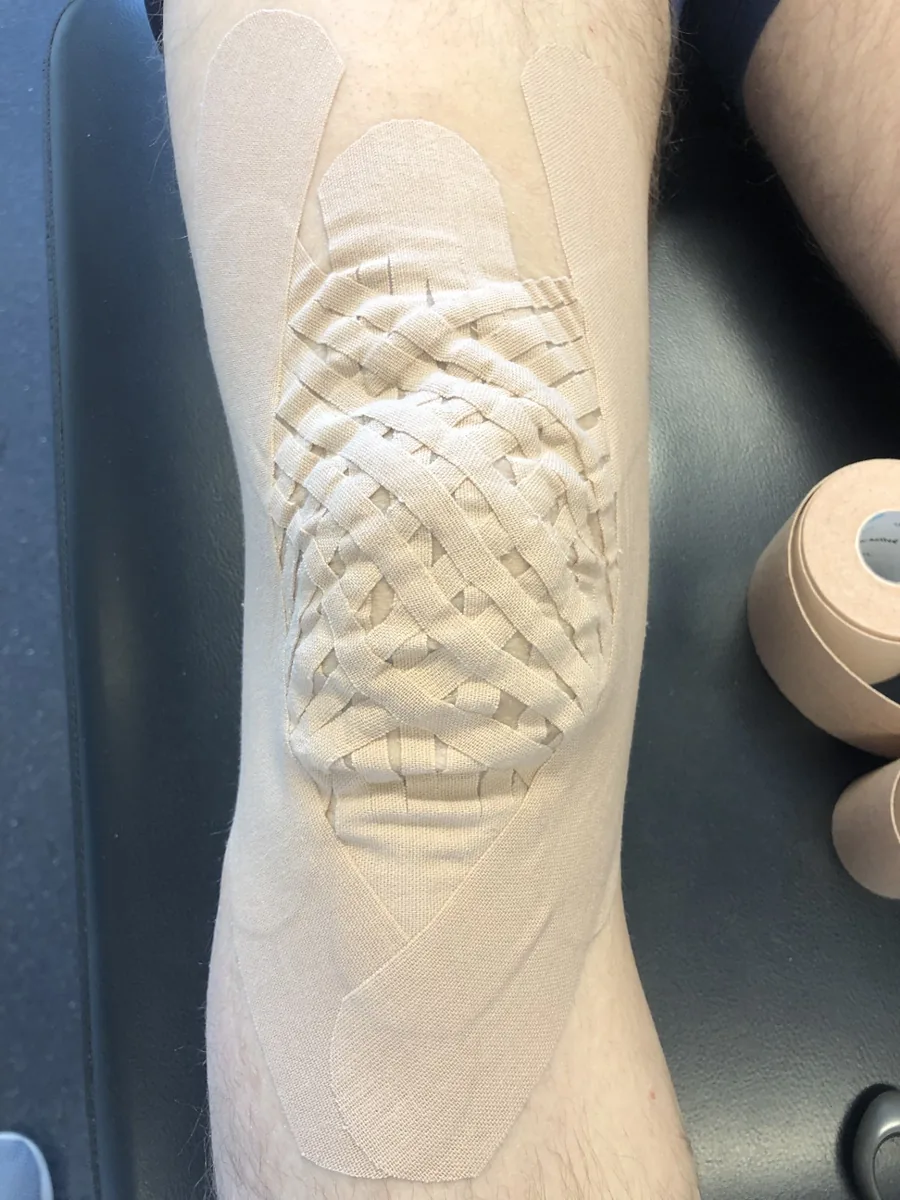
Methods: Fifty-six patients were randomly assigned to kinesiotaping (space-correction/lifting technique, repeated three times at one-week intervals) or naproxen (250 mg TID for 10 days) plus ten daily physical therapy sessions. Pain (VAS) and swelling depth (sonography) were measured before and after treatment.
Results: Kinesiotaping significantly decreased pain and swelling compared with naproxen/physical therapy after adjustment for baseline (P = 0.0001 for both). One patient had mild local skin irritation.
Conclusion: Kinesiotaping was more effective than naproxen plus physical therapy in reducing pain and swelling in pes anserinus tendino-bursitis.
Short-Term Effects of Kinesio Taping in Women with Pregnancy-Related Low Back Pain: A Randomized Controlled Clinical Trial
Şeyhmus Kaplan, Mahmut Alpayci, Erbil Karaman, Orkun Çetin, Yasemin Özkan, Server İlter, et al.
Medical Science Monitor, 2016 · RCT
Space correctionInhibisjonRyggGraviditet
Les sammendrag
Background: Pregnancy-related low back pain is common. This study investigated short-term effects of lumbar Kinesio taping on pain intensity and disability.
Methods: Sixty-five women were randomized to Kinesio taping plus paracetamol (n = 33) or paracetamol alone (n = 32). Four I-shaped tapes were applied in lumbar flexion: two horizontal bands with space correction technique, and two vertical bands with inhibition technique. Outcomes were VAS pain and Roland-Morris Disability Questionnaire at 5 days.
Results: Both groups improved significantly. The Kinesio taping group showed significantly greater improvement in all outcome measures (P < 0.001).
Conclusions: Kinesio taping can be used as a complementary treatment for pregnancy-related low back pain.
The effects of kinesiology taping therapy on degenerative knee arthritis patients' pain, function, and joint range of motion
Kwansub Lee, Chae-Woo Yi, Sangyong Lee
Journal of Physical Therapy Science, 2016 · Kontrollert studie
Multi-muskel tapingKneArtroseROM
Les sammendrag
Purpose: To examine effects of kinesiology taping on pain, function and joint range of motion in degenerative knee arthritis patients.
Subjects: Thirty patients were divided into conservative treatment (n = 15) or kinesiology taping (n = 15).
Methods: Treatment three times per week for four weeks. Elastic tape was applied to hamstrings, anterior tibialis, quadriceps and gastrocnemius. Outcomes: goniometric ROM, VAS pain, and Korean WOMAC index.
Results: Both groups improved within-group. The kinesiology taping group showed significantly lower VAS and WOMAC scores and significantly greater ROM than the conservative treatment group.
Conclusion: Kinesiology taping is considered an effective non-surgical intervention for pain relief, daily activities and range of motion in degenerative knee arthritis patients.
Disse studiene er publisert i vitenskapelige tidsskrift og er utvalgt fordi de gjelder kliniske områder der jeg bruker tape i praksis. De er ikke en garanti for effekt hos den enkelte pasient.